

As part of our comprehensive guide to agent skills, this article dives deep into one of the most common points of confusion in AI agent development. If you’re new to agent architectures, start with the main guide before exploring these technical distinctions.
Understanding the difference between agent skills and function calling is essential for designing effective AI systems. While both concepts extend an agent’s capabilities, they serve fundamentally different purposes.
Table of Contents
- The Core Distinction
- What Is Function Calling?
- What Are Agent Skills?
- Side-by-Side Comparison
- When to Use Function Calling
- When to Use Agent Skills
- The Synergy: Skills and Tools Together
- Common Misconceptions
- Implementation Patterns
- Conclusion
The Core Distinction
The simplest way to understand the difference is through an analogy:
- Function calling is the agent’s hands – the ability to reach out and interact with external systems
- Agent skills are the agent’s training – the expertise that guides how and when to use those hands
Function calling provides execution capability. Agent skills provide strategic intelligence. Both are necessary for sophisticated AI agents, but they solve different problems.
What Is Function Calling?
Function calling, often called “tool use,” enables AI models to interact with external APIs, databases, and systems. When a model encounters a query requiring external information or action, it can invoke predefined functions to fulfill the request.
How Function Calling Works
The typical function calling workflow follows these steps:
1. Intent Detection
The model analyzes the user’s request and determines that external action is required. This might be fetching real-time data, performing a calculation, or updating a system.
2. Function Selection
From its available tool library, the model selects the appropriate function. Modern models can choose from dozens or hundreds of available tools.
3. Parameter Extraction
The model extracts required parameters from the conversation context. This involves parsing natural language into structured data.
4. Execution and Response
The external system processes the function call and returns results. The model then incorporates these results into its response.
Function Calling Characteristics
Function calling has several defining traits:
- Reactive – Functions are called in response to specific needs
- Deterministic – Given the same inputs, functions produce consistent outputs
- Single-purpose – Each function performs one specific task
- Stateless – Functions don’t retain information between calls
Common Function Calling Use Cases
Function calling excels at:
- Retrieving real-time data (weather, stock prices, news)
- Performing calculations and data transformations
- Interacting with databases and APIs
- Controlling external systems and IoT devices
- Processing payments and transactions
What Are Agent Skills?
Agent skills represent packaged expertise that shapes how an agent reasons about problems. They are not code to execute but knowledge to apply.
Skills provide:
- Domain knowledge – Subject matter expertise in specific fields
- Behavioral patterns – Preferred approaches to common situations
- Decision frameworks – Structured methods for making choices
- Contextual awareness – Understanding of when to apply which strategies
How Agent Skills Work
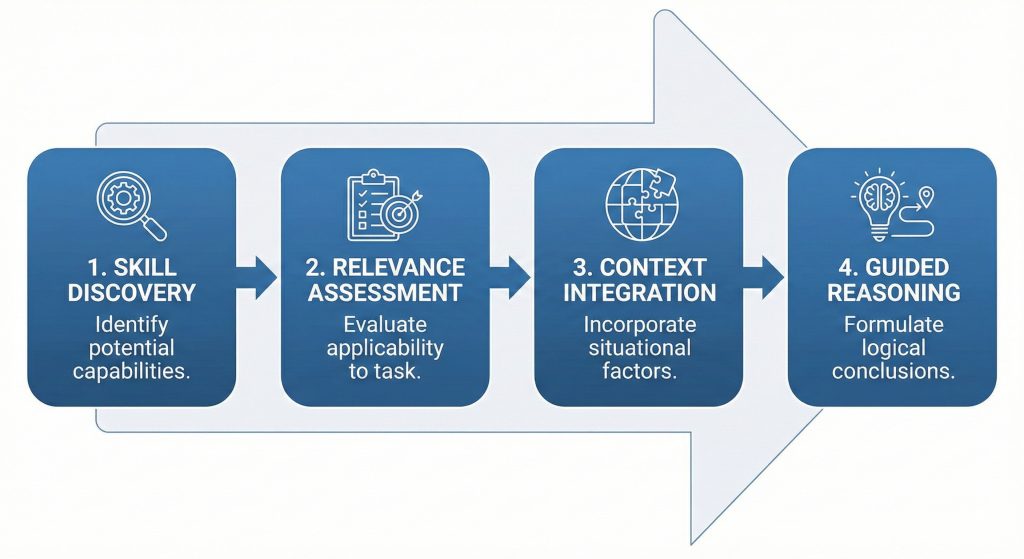
Skills operate through contextual loading:
1. Skill Discovery
The agent identifies available skills based on its configuration. Skills are typically organized as files or resources in known locations.
2. Relevance Assessment
Based on the current task or conversation, the agent determines which skills are relevant. Not all skills are loaded for every interaction.
3. Context Integration
Relevant skill content is incorporated into the agent’s working context. This might include instructions, examples, or reference materials.
4. Guided Reasoning
The skill’s guidance influences how the agent thinks through the problem. The agent doesn’t just have access to information—it has a framework for using it.
Agent Skills Characteristics
Skills have distinct properties:
- Proactive – Skills shape thinking before action is needed
- Contextual – Different skills activate in different situations
- Strategic – Skills guide decisions across multiple steps
- Persistent – Skill knowledge influences ongoing interactions
Side-by-Side Comparison
Understanding these concepts requires examining them together:
| Aspect | Function Calling | Agent Skills |
|---|---|---|
| Purpose | Execute actions | Guide decisions |
| Nature | Code execution | Knowledge application |
| Timing | During task execution | Before and during reasoning |
| Scope | Single operation | Entire problem domain |
| State | Stateless | Contextual |
| Output | Data/action result | Reasoning process |
| Metaphor | Hands | Training |
The distinction becomes clearer with an example. Consider an agent helping with financial analysis:
Function Calling Perspective:
-
- Call `get_stock_price(symbol)` to retrieve prices
-
- Call `calculate_ratio(a, b)` for financial ratios
-
- Call `fetch_earnings(company)` for company data
Agent Skills Perspective:
-
- Apply value investing analysis framework
-
- Use conservative risk assessment guidelines
-
- Follow SEC compliance requirements
-
- Structure recommendations in professional format
The functions provide capabilities. The skills determine which capabilities to use, when, and how to interpret results.
When to Use Function Calling
Function calling is the right choice when you need:
Real-Time Data Access
Functions excel at retrieving current information:
- Current market prices
- Weather conditions
- System status
- User account information
System Integration
Connect your agent to existing infrastructure:
- CRM platforms
- Database systems
- Third-party APIs
- Internal microservices
Action Execution
Enable agents to take real-world actions:
- Send emails
- Create records
- Process transactions
- Update configurations
Computational Tasks
Offload heavy processing:
- Complex calculations
- Data transformations
- File operations
- Search and retrieval
When to Use Agent Skills
Agent skills are appropriate when you need:
Domain Expertise
Embed specialized knowledge:
- Industry regulations
- Technical standards
- Best practices
- Professional methodologies
Consistent Behavior
Ensure reliable patterns:
- Response formatting
- Decision criteria
- Quality standards
- Brand voice
Complex Reasoning
Guide multi-step thinking:
- Problem decomposition
- Trade-off analysis
- Risk assessment
- Recommendation frameworks
Knowledge Management
Organize institutional expertise:
- Process documentation
- Troubleshooting guides
- Historical context
- Organizational policies
The Synergy: Skills and Tools Together
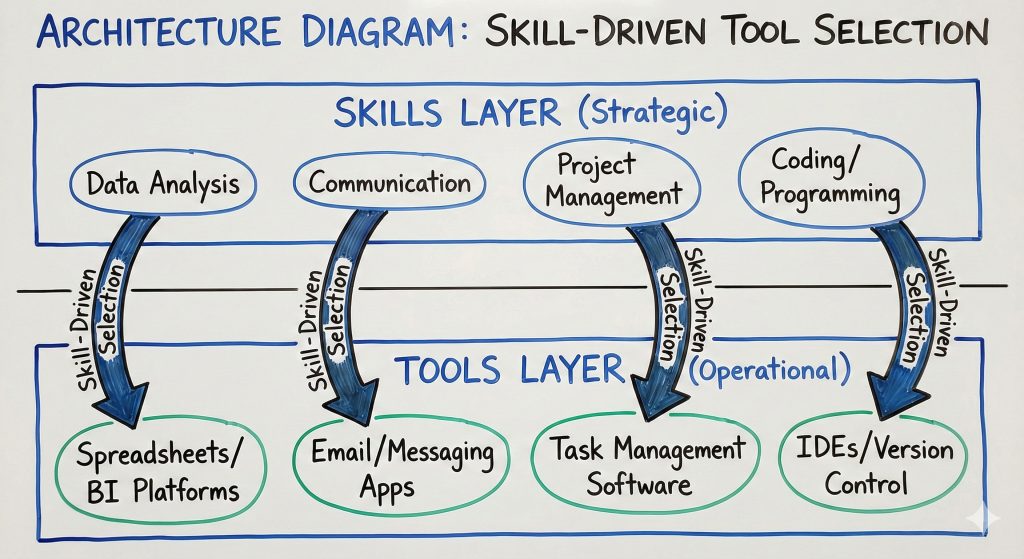
The most powerful agents combine skills and function calling effectively. Skills determine strategy while functions provide execution capability.
An Integrated Example
Consider a customer support agent handling a refund request:
Skills provide:
-
- Refund policy knowledge
-
- Escalation criteria
-
- Customer communication guidelines
-
- Resolution prioritization framework
Functions provide:
-
- `lookup_order(order_id)` – Retrieve order details
-
- `check_refund_eligibility(order_id)` – Validate against policy
-
- `process_refund(order_id, amount)` – Execute the refund
-
- `send_notification(customer_id, message)` – Inform the customer
The skill tells the agent how to think about the refund request. The functions let the agent take action based on that thinking.
Skill-Driven Tool Selection
Advanced agents use skills to guide tool selection. Rather than exposing all available functions, skills can:
- Recommend appropriate tools for situations
- Provide guidance on tool usage patterns
- Establish safety constraints on tool invocation
- Sequence tool usage for complex workflows
For more on designing these integrated systems, see our guide on Agent Skills Architecture.
Common Misconceptions
Several misunderstandings persist about skills and function calling.
Misconception: Skills Are Just Fancy Prompts
While skills may include prompt-like instructions, they’re more than that. Skills encompass:
- Dynamic discovery and loading mechanisms
- Resource organization and versioning
- Contextual activation logic
- Integration with broader agent architectures
Prompts are static input. Skills are managed, modular capabilities.
Misconception: Function Calling Replaces Skills
Functions and skills are complementary, not competitive. An agent with only functions lacks reasoning strategy. An agent with only skills lacks action capability.
Enterprise-grade agents need both.
Misconception: Skills Execute Code
This is a fundamental error. Skills explicitly do not execute code. They shape thinking, not action. Code execution belongs to the function calling layer.
Some platforms blur this distinction in their terminology, but the underlying separation remains important.
Misconception: More Functions Means Better Agents
Having hundreds of available functions doesn’t make an agent effective. Without skills to guide tool selection and usage, more functions often create more confusion.
Implementation Patterns
When building agents that combine skills and functions, several patterns prove useful.
Pattern: Skill-Gated Tool Access
Only expose certain functions when specific skills are active. This prevents inappropriate tool usage and reduces decision complexity.
if skill("financial-analysis").active:
    enable_tools(["market_data", "financial_calculations"])
else:
    disable_tools(["market_data", "financial_calculations"])
Pattern: Skill-Provided Tool Instructions
Include tool usage guidance within skill definitions. This keeps tool expertise co-located with domain expertise.
Pattern: Hierarchical Skill-Tool Mapping
Organize skills and tools in parallel hierarchies. Domain skills correspond to domain tool sets, simplifying management and discovery.
For security implications of these patterns, review our article on Agent Skills Security.
Conclusion
Understanding the distinction between agent skills and function calling is fundamental to building effective AI agents. These concepts are complementary, not competitive:
- Function calling provides the execution capability that lets agents interact with the world
- Agent skills provide the strategic intelligence that guides those interactions
The best agents combine both. Skills determine what to do and how to think. Functions determine how to do it. Together, they enable AI systems that are both capable and thoughtful.
When designing your next agent, consider:
- What domain expertise does this agent need? (Skills)
- What external actions must it take? (Functions)
- How should expertise guide action selection? (Integration)
By answering these questions, you’ll create agents that leverage both skills and tools effectively.
For practical guidance on implementing these concepts, continue to How to Build Agent Skills.