

As part of our comprehensive guide to agent skills, this article explores the architectural patterns and design decisions that underpin enterprise-grade skill systems. If you’re still learning the basics, start with How to Build Agent Skills before diving into these advanced concepts.
Understanding skill architecture is essential for teams building scalable AI agent platforms. The right architecture enables growth, maintainability, and governance.
Table of Contents
- Why Architecture Matters
- Core Architectural Principles
- Skill Discovery Patterns
- Skill Composition Strategies
- Context Management Architecture
- Skill Registry Design
- Versioning and Lifecycle Management
- Multi-Agent Skill Sharing
- Performance Optimization
- Implementation Approaches
- Conclusion
Why Architecture Matters
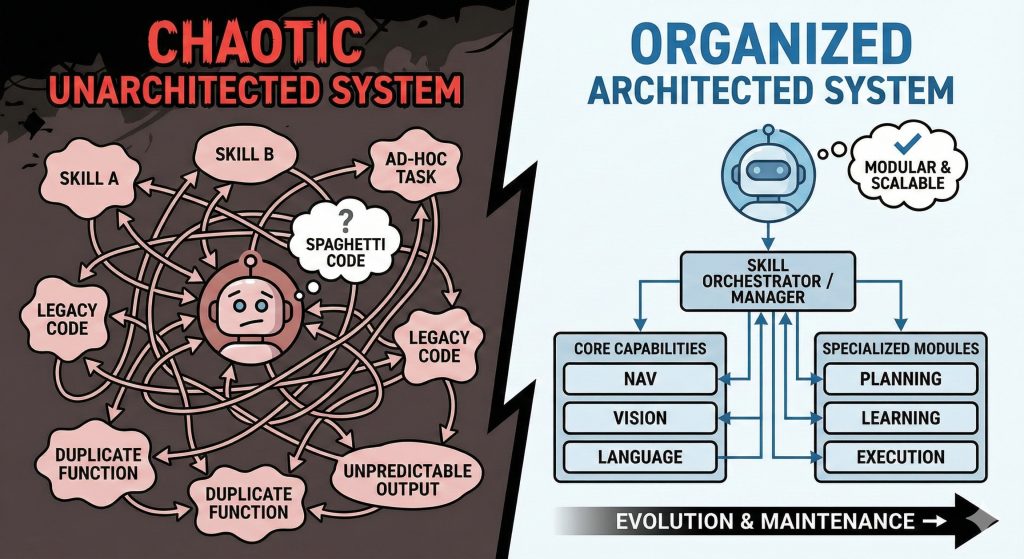
Individual skills are relatively simple. But as skill libraries grow from 10 to 100 to 1,000 skills, architectural decisions become critical.
Poor architecture leads to:
- Skill conflicts and inconsistent behavior
- Context window exhaustion
- Maintenance nightmares
- Deployment complications
- Governance gaps
Good architecture enables:
- Seamless skill composition
- Efficient context utilization
- Independent skill development
- Clear ownership and accountability
- Enterprise-grade governance
The architectural investment pays dividends as your AI systems mature.
Core Architectural Principles
Several principles guide effective skill architecture.
Principle 1: Separation of Concerns
Each skill should have a single, clear responsibility. Skills that try to do too much become fragile and difficult to maintain.
Separation of concerns means:
- One skill per domain or workflow
- Clear boundaries between skill responsibilities
- Explicit handoff points between skills
- No overlapping instruction sets
Principle 2: Loose Coupling
Skills should be independent. Changes to one skill shouldn’t require changes to others.
Loose coupling enables:
- Independent development by different teams
- Deployment without coordination
- Testing in isolation
- Replacement without system impact
Principle 3: High Cohesion
Related functionality should stay together within a skill. All instructions about a topic should live in one place.
High cohesion produces:
- Easier maintenance
- Clearer ownership
- Better discoverability
- More consistent behavior
Principle 4: Progressive Disclosure
Not everything needs to load at once. Skills should reveal detail progressively as needed.
Progressive disclosure conserves:
- Context window space
- Agent attention
- User patience
- Computational resources
Skill Discovery Patterns
How agents find and load skills is a fundamental architectural decision.
Pattern: File System Discovery
Skills are organized in known directory structures. The agent scans these directories to discover available skills.
/skills/
├── customer-support/
│   ├── SKILL.md
│   └── examples/
├── financial-analysis/
│   ├── SKILL.md
│   └── templates/
└── technical-support/
    ├── SKILL.md
    └── scripts/
Advantages:
-
- Simple implementation
-
- Easy to understand
-
- Works with version control
-
- No external dependencies
Disadvantages:
-
- Limited metadata querying
-
- No runtime registration
-
- Scaling challenges at large volumes
Pattern: Registry-Based Discovery
A centralized registry maintains skill metadata and locations. Agents query the registry to find relevant skills.
Registry Fields:
-
- Skill identifier
-
- Location (URL, path, or embedded)
-
- Metadata (description, version, author)
-
- Activation conditions
-
- Dependencies
Advantages:
-
- Rich metadata querying
-
- Runtime skill registration
-
- Cross-platform support
-
- Centralized governance
Disadvantages:
-
- Additional infrastructure required
-
- Registry becomes a dependency
-
- Synchronization complexity
Pattern: Context-Triggered Discovery
The agent determines skill relevance based on the current conversation or task. Skills are loaded dynamically as needs emerge.
Trigger Types:
-
- Keyword matching
-
- Intent classification
-
- Explicit user request
-
- Tool invocation patterns
Advantages:
-
- Optimal context utilization
-
- Responsive to conversation flow
-
- Reduces cold-start overhead
Disadvantages:
-
- Classification errors cause missed skills
-
- Latency for skill loading
-
- Complexity in trigger definition
Hybrid Approaches
Most production systems combine patterns:
- Registry provides catalog of available skills
- Context analysis determines relevance
- File system delivers skill content
[IMAGE PROMPT: Architecture diagram showing registry, context analyzer, and file system working together for skill discovery]
Skill Composition Strategies
Complex tasks often require multiple skills working together. Composition strategies determine how skills combine.
Strategy: Flat Composition
All relevant skills load into the same context level. The agent reasons across all skill instructions simultaneously.
Agent Context:
├── Skill A instructions
├── Skill B instructions
└── Skill C instructions
Best for:
-
- Small skill sets
-
- Closely related skills
-
- Simple workflows
Risks:
-
- Instruction conflicts
-
- Context overflow
-
- Unclear precedence
Strategy: Hierarchical Composition
Skills organize into parent-child relationships. Parent skills may invoke child skills for specific subtasks.
Agent Context:
└── Parent Skill
    ├── Child Skill 1 (on demand)
    └── Child Skill 2 (on demand)
Best for:
-
- Complex workflows
-
- Clear task decomposition
-
- Large skill libraries
Risks:
-
- Deep hierarchies slow processing
-
- Complexity in skill design
-
- Navigation overhead
Strategy: Pipeline Composition
Skills execute in sequence, each transforming the output for the next.
Input → Skill A → Skill B → Skill C → OutputBest for:
-
- Multi-step workflows
-
- Clear stage transitions
-
- Assembly-line tasks
Risks:
-
- Rigid workflow structure
-
- Error propagation
-
- Limited flexibility
Strategy: Advisor Composition
Multiple skills provide parallel input, with the agent synthesizing recommendations.
          ┌── Skill A ──┐
Input ────┼── Skill B ──┼──→ Synthesis → Output
          └── Skill C ──┘
Best for:
-
- Decision support
-
- Multi-perspective analysis
-
- Conflict resolution
Risks:
-
- Conflicting advice
-
- Synthesis complexity
-
- Context consumption
Context Management Architecture
Managing the finite context window is perhaps the most critical architectural challenge.
Context Budget Allocation
Establish explicit budgets for context components:
| Component | % Budget |
|---|---|
| System instructions | 10% |
| Active skills | 30% |
| Conversation history | 30% |
| Working memory | 20% |
| Safety margin | 10% |
Budget allocation prevents any single component from crowding out others.
Skill Summarization
When full skill content exceeds budget, summarization provides essential guidance in reduced form.
Summarization Levels:
- Full – Complete skill instructions
- Standard – Core procedures only
- Minimal – Key decision points only
- Reference – Skill exists but load on demand
Context Compression Techniques
Several techniques reduce skill footprint:
- Deduplication – Remove redundant content across skills
- Progressive loading – Start minimal, expand as needed
- Just-in-time injection – Add content only when referenced
- Sliding window – Rotate less-relevant content out
Memory Architecture
Long-term memory systems extend effective context:
- Persistent storage – Retain information across sessions
- Semantic search – Retrieve relevant prior context
- Summarization chains – Compress history while preserving key facts
Skill Registry Design
For organizations with growing skill libraries, a registry becomes essential.
Registry Schema
A comprehensive registry tracks:
{
  "registryVersion": "1.0",
  "skills": [
    {
      "id": "customer-refunds",
      "name": "Customer Refund Processor",
      "version": "2.1.0",
      "description": "Guides refund decisions for subscription products",
      "author": "customer-success-team",
      "location": "/skills/customer-refunds/SKILL.md",
      "activationTriggers": ["refund", "return", "money back"],
      "dependencies": ["customer-verification"],
      "permissions": ["read:orders", "write:refunds"],
      "status": "active",
      "created": "2024-01-15T00:00:00Z",
      "updated": "2024-11-20T00:00:00Z"
    }
  ]
}
Registry Operations
Essential registry capabilities:
- Register – Add new skills to the catalog
- Discover – Query skills by metadata
- Resolve – Locate skill content from identifier
- Validate – Verify skill integrity and format
- Deprecate – Mark skills for retirement
Registry Governance
Establish policies for registry management:
- Who can add skills?
- What review process applies?
- How are conflicts resolved?
- When are skills retired?
Versioning and Lifecycle Management
Skills evolve over time. Versioning ensures smooth transitions.
Semantic Versioning
Apply semantic versioning to skills:
- Major (X.0.0) – Breaking changes to behavior
- Minor (x.Y.0) – New capabilities, backward compatible
- Patch (x.y.Z) – Bug fixes and clarifications
Lifecycle Stages
Skills progress through defined stages:
- Draft – Under development, not for production
- Active – Approved for production use
- Deprecated – Scheduled for retirement
- Retired – No longer available
Migration Strategies
When skills require major updates:
- Blue-Green – Run old and new versions simultaneously
- Canary – Gradually shift traffic to new version
- Feature Flag – Enable new version for specific users/agents
Compatibility Management
Track compatibility requirements:
- Minimum agent version
- Required dependencies
- Conflicting skills
- Platform restrictions
For security implications of versioning, see Agent Skills Security.
Multi-Agent Skill Sharing
Enterprise environments often involve multiple agents sharing skills.
Shared Skill Libraries
Centralized libraries serve multiple agents:
/shared-skills/
├── organization-policies/
├── communication-standards/
└── security-guidelines/

/agent-a/skills/
└── domain-specific-a/

/agent-b/skills/
└── domain-specific-b/
Skill Inheritance
Agents can inherit from base skill sets:
BaseAgent
├── Organization Policies
├── Security Standards
└── Communication Guidelines

CustomerAgent extends BaseAgent
└── Customer Service Skills

TechnicalAgent extends BaseAgent
└── Technical Support Skills
Cross-Agent Consistency
Ensure consistent behavior across agents:
- Shared decision criteria
- Common terminology
- Aligned escalation paths
- Unified quality standards
[IMAGE PROMPT: Diagram showing shared skill library at center with multiple agents connecting to it plus their own specialized skills]
Performance Optimization
Large skill systems require optimization for responsive performance.
Skill Caching
Cache frequently-used skills:
- Memory cache – Fast access for hot skills
- Preloading – Load common skills at startup
- Warm pools – Keep popular skills ready
Lazy Loading
Defer loading until needed:
- Load skill metadata first
- Retrieve full content on activation
- Unload inactive skills to free context
Indexing and Search
Efficient skill discovery requires indexing:
- Keyword indexes for trigger matching
- Semantic embeddings for concept matching
- Category hierarchies for browsing
Profiling and Monitoring
Track skill performance metrics:
- Load time per skill
- Activation frequency
- Context consumption
- Error rates
Implementation Approaches
Different platforms implement skill architecture differently.
File-Based Implementation
Platforms like Google Antigravity use file-based skill organization:
- Skills stored as markdown files
- Directory structure defines organization
- Agent scans configured paths
- Simple, transparent, version-controllable
Framework-Based Implementation
Frameworks like Spring AI integrate skills into application architecture:
- Skills defined as beans or components
- Dependency injection manages loading
- Advisor chains enable composition
- Enterprise patterns apply
Platform-Managed Implementation
Managed platforms abstract skill infrastructure:
- Skills uploaded to platform
- Platform handles discovery and loading
- Limited customization of architecture
- Reduced operational burden
Custom Implementation
Large organizations may build custom skill systems:
- Full control over architecture
- Integration with existing systems
- Maximum flexibility
- Highest development investment
Conclusion
Skill architecture may seem like over-engineering for small projects. But as AI agent deployments grow, architectural decisions increasingly determine success or failure.
Key architectural takeaways:
- Plan for growth – Design for 100 skills even if you have 5
- Separate concerns – Keep skills focused and independent
- Manage context intentionally – Context is your scarcest resource
- Version everything – Enable smooth evolution
- Govern centrally – Maintain organizational oversight
The investment in proper architecture pays returns in maintainability, scalability, and reliability. Start with solid foundations, and your skill library will grow without collapsing under its own weight.
When implementing skills in production, ensure you’ve addressed the security considerations in Agent Skills Security.
[…] Agent Skills Architecture: Designing Modular AI Capabilities – Technical deep-dive into skill system design patterns and architectures. […]
[…] For architectural considerations when managing multiple skills, see Agent Skills Architecture. […]
[…] For more on designing these integrated systems, see our guide on Agent Skills Architecture. […]